
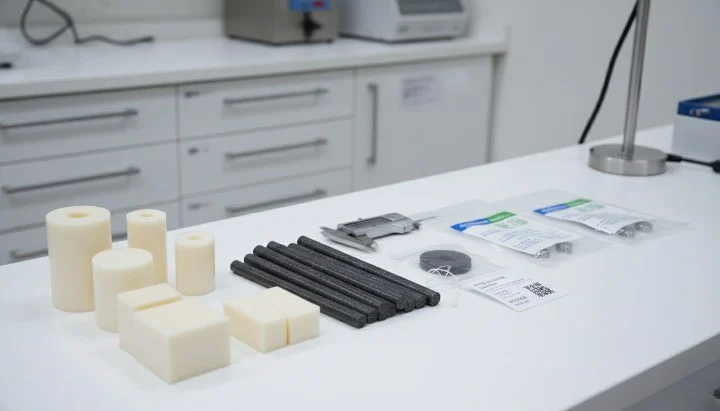

The choice of material for a bone implant affects the outcome of surgery, the ability to monitor bone union, and the long-term stability of the reconstruction. Two of the most commonly used materials — PEEK and titanium — have different properties that determine their applications in orthopedics, spinal surgery, cranioplasty, and maxillofacial reconstruction.
Key points:
- PEEK has an elastic modulus closer to that of bone than titanium, which theoretically reduces the risk of stress shielding.
- Titanium provides natural osseointegration; unmodified PEEK requires surface modification.
- PEEK produces minimal artifacts on CT/MRI; titanium causes pronounced artifacts.
- Titanium has higher fatigue strength for high-load areas.
- The choice depends on the clinical objective, defect location, imaging requirements, and the individual characteristics of the patient.
What are PEEK and titanium in the context of medical implants?
PEEK (polyether ether ketone) is a bioinert high-performance thermoplastic polymer used to manufacture medical implants because of its mechanical properties and chemical stability. PEEK does not actively interact biologically with the tissues of the body.
Medical-grade titanium is a biocompatible metal that has been widely used for implants for decades. Titanium is capable of osseointegration — the formation of direct contact between bone tissue and the implant surface without an intervening connective tissue layer.
Both materials are used in various fields of surgery:
- orthopedics and traumatology — plates, screws, joint prostheses;
- spinal surgery — intervertebral cages, fixation systems;
- cranioplasty — reconstruction of skull defects;
- maxillofacial surgery — reconstruction of facial bones;
- neurosurgery — cranial implants;
- dental implantology — dental implants.
Neither material is universally “better.” The choice depends on the clinical objective, defect location, imaging requirements, expected loads, and the condition of the patient’s tissues.
Key differences: clinically significant properties of PEEK vs titanium
Elastic modulus and the risk of stress shielding
Elastic modulus is a measure of a material’s stiffness. The higher it is, the less the material deforms under load.
PEEK has an elastic modulus of approximately 3–4 GPa, while titanium is approximately 110 GPa; cortical bone is approximately 10–30 GPa. PEEK is closer to bone in terms of stiffness. When an implant is stiffer than bone, it carries a greater proportion of the load. This may lead to stress shielding — a phenomenon in which the bone surrounding the implant receives less mechanical stimulation for remodeling.
Because of its lower stiffness, PEEK is theoretically less prone to stress shielding. However, this does not automatically translate into a clinical advantage in all situations. The impact of stress shielding depends on implant design, anatomical location, type of loading, and the condition of the patient’s bone.
Biocompatibility and osseointegration
Titanium demonstrates a natural ability to osseointegrate. Bone tissue can form direct contact with the surface of a titanium implant, providing stable fixation.
Unmodified PEEK is a bioinert material. Systematic reviews show that it tends to promote the formation of a fibrous capsule (a connective tissue layer) around the implant rather than direct contact with bone. This may limit biological integration.
To improve PEEK osseointegration, surface modifications are used:
- texturing;
- hydroxyapatite coating;
- creation of porous structures;
- combination with titanium components.
Modified PEEK may improve the biological response, but its underlying bioinert nature remains a characteristic of the material. If rapid and reliable osseointegration is critical, titanium has an evidence-based advantage. If bioinertness is acceptable or even desirable, PEEK may be an appropriate choice.
Radiolucency and artifacts on CT/MRI
PEEK produces minimal artifacts on computed tomography (CT) and magnetic resonance imaging (MRI). This allows clear visualization of bone tissue around the implant and assessment of the bone union process after surgery.
Titanium produces pronounced metallic artifacts on CT and MRI. These artifacts can make it more difficult to assess bone condition, detect complications, or plan revision procedures. Titanium is generally considered an MRI-safe material, but local image distortion may limit the diagnostic value of imaging in the area of the implant.
If regular postoperative monitoring of bone union is required or there is a risk of complications requiring imaging, PEEK has an advantage. Most PEEK devices use radiopaque markers to monitor implant position on imaging.
Strength and fatigue resistance
Titanium has high strength and fatigue resistance. It withstands cyclic loading well over long periods, making it a reliable choice for high-load areas.
PEEK has sufficient strength for many applications, but its mechanical properties depend on implant design and loading conditions. In some high-load scenarios, titanium may have an advantage in terms of durability.
In areas exposed to constant high loads (for example, dental implants and certain orthopedic constructs), titanium has a larger evidence base regarding long-term stability.
Machinability and potential for customization
Both materials support modern manufacturing technologies, including 3D printing.
Titanium allows the creation of porous structures that improve osseointegration and load distribution. 3D printing of titanium is widely used for patient-specific implants.
PEEK can also be processed using additive manufacturing technologies. It is easier to machine, providing flexibility in the production of complex geometries.
Both materials make it possible to create customized solutions based on the anatomy of a specific patient.
| Property | PEEK | Titanium | Clinical significance |
|---|---|---|---|
| Elastic modulus | Closer to bone (3–4 GPa) | Significantly higher than bone (110 GPa) | PEEK theoretically has a lower risk of stress shielding; the clinical effect depends on implant design |
| Osseointegration | Requires surface modification | Natural capability | Titanium provides faster and more reliable bone integration |
| Radiolucency | Minimal artifacts | Pronounced artifacts | PEEK allows monitoring of bone union on CT/MRI |
| Strength | Sufficient for most applications | High fatigue resistance | Titanium is more reliable in high-load areas |
| Customization | Supports 3D printing | Supports 3D printing | Both materials allow patient-specific modeling |
Advantages and limitations of each material
PEEK — strengths and limitations
Strengths:
- stiffness closer to that of bone theoretically reduces the risk of stress shielding;
- minimal artifacts allow clear visualization of bone on CT and MRI;
- possibility of customization using 3D printing;
- chemical stability in the biological environment.
Limitations:
- inherent bioinertness requires surface modification to improve osseointegration;
- in its unmodified form, it tends to promote fibrous capsule formation;
- in high-load areas, it may require additional structural support;
- a smaller evidence base compared with titanium for some applications.
Titanium — strengths and limitations
Strengths:
- predictable osseointegration without additional modifications;
- high strength and fatigue resistance;
- extensive clinical experience and evidence base across various fields of surgery;
- ability to create porous structures to improve biological integration;
- reliability in high-load areas.
Limitations:
- pronounced artifacts on CT and MRI make bone visualization more difficult;
- greater stiffness may lead to stress shielding in some scenarios;
- strong osseointegration may make implant removal more difficult during revision procedures;
- its metallic nature may be undesirable for patients with metal sensitivity.
When PEEK is chosen and when titanium is chosen: typical clinical scenarios
When PEEK is more commonly chosen
Spinal surgery — intervertebral cages:
In some clinical practices, PEEK is used for intervertebral cages. Its minimal artifacts make it possible to monitor spinal fusion on follow-up CT scans. Its elastic modulus being closer to that of bone theoretically reduces the risk of stress shielding.
At the same time, systematic reviews and meta-analyses show that 3D-printed titanium cages in the lumbar spine demonstrated better fusion and osseointegration rates compared with PEEK in available comparative studies.
Cranioplasty:
For reconstruction of skull defects, PEEK is often used because it enables the production of patient-specific implants that precisely match the patient’s anatomy. Minimal artifacts allow assessment of bone and soft tissues after surgery.
A meta-analysis of patient-specific craniofacial implants found no statistically significant differences between PEEK and titanium in overall complications, infections, and explantation rates.
Maxillofacial surgery:
In aesthetically sensitive areas with moderate loads, PEEK may be an appropriate choice. It can be shaped according to specific anatomy, and minimal artifacts facilitate postoperative monitoring.
When titanium is more commonly chosen
Dental implantology:
Titanium is the preferred choice in dental implantology and has the largest evidence base for tooth replacement. Its ability to osseointegrate, high strength, and decades of clinical experience make it a reliable option.
High-load orthopedic constructs:
In areas exposed to constant high loads (for example, plates for osteosynthesis of long bones and fixation screws), titanium has an advantage in terms of strength and fatigue resistance.
Situations where rapid osseointegration is critical:
If the clinical objective requires rapid and reliable bone integration with the implant, titanium has an evidence-based advantage. Preclinical data consistently demonstrate better osseointegration of titanium compared with unmodified PEEK.
Hybrid solutions
In some cases, combined approaches are used:
- PEEK implants with titanium coating or titanium components;
- porous PEEK structures with hydroxyapatite coating;
- combination of PEEK and titanium within a single construct.
Such solutions may combine the advantages of both materials, but their use depends on clinical indications and the availability of the required technologies.
These are typical rather than universal scenarios. The final choice of material is an individualized decision made by the surgeon based on clinical data, the evidence base, and the specific characteristics of the patient.
3D printing and patient-specific implants: possibilities for both materials
Additive manufacturing technologies have changed the approach to medical implant production. 3D printing makes it possible to create devices that precisely match the anatomy of a specific patient, which improves load distribution, reduces the risk of complications, and accelerates recovery.
How a patient-specific implant is created
- Obtaining the patient’s medical data — the surgeon provides CT or MRI data in DICOM format.
- Creating a digital 3D model — a three-dimensional model of the anatomical area is generated from the medical data.
- Implant design — engineers develop a construct that takes into account the shape of the defect, mechanical loads, and fixation requirements.
- Approval by the surgeon — the physician reviews the digital model for compliance with clinical requirements and makes adjustments if necessary.
- Manufacturing — the implant is produced using a 3D printer.
- Quality control — the finished device is checked for geometric accuracy, strength, and compliance with specifications.
- Sterilization and packaging — the implant is sterilized and delivered to the surgeon ready for surgery.
Advantages of customization
Patient-specific implants make it possible to:
- accurately reproduce the patient’s anatomy;
- improve load distribution;
- reduce the risk of mismatch between the implant and the defect;
- reduce operating time through preoperative planning;
- create porous structures to improve osseointegration (for titanium).
Possibilities for PEEK and titanium
3D-printed titanium makes it possible to create complex porous structures that mimic cancellous bone. This improves osseointegration and reduces implant stiffness. 3D-printed titanium implants are widely used in spinal surgery, orthopedics, and cranioplasty.
PEEK also supports additive manufacturing technologies. It is easier to machine, providing flexibility in the production of complex geometries. PEEK can be combined with other materials or its surface can be modified to improve the biological response.
Both materials make it possible to create patient-specific solutions, but the choice depends on the clinical objective, indications, and regulatory requirements.
Patient-specific implants from biodrook: a collaborative process with the surgeon
biodrook is a Ukrainian medical technology company that develops and manufactures patient-specific 3D-printed bone implants. The company works as an engineering partner for surgeons, providing a complete cycle from receiving medical data to delivering the finished sterile device.
How biodrook works
- Obtaining medical data — the surgeon provides the patient’s CT or MRI data in DICOM format.
- Creating a digital model — the biodrook team builds a three-dimensional model of the anatomical area and designs the implant.
- Approval by the surgeon — the physician reviews the digital model for compliance with clinical requirements. Adjustments are made if necessary.
- Manufacturing — the implant is produced using biodrook’s own equipment.
- Quality control — the finished device undergoes multilevel verification of geometric accuracy and strength.
- Sterilization and delivery — the implant is sterilized, packaged, and delivered to the surgeon together with the accompanying documentation.
Regulatory compliance
In the European Union, individual patient-specific implants are regulated as custom-made medical devices and must comply with the requirements of Regulation (EU) 2017/745 (MDR). For Class III implantable devices, the conformity assessment procedure under Annex XIII and Annex IX Chapter I applies.
The manufacturer must implement a documented quality management system and prepare technical documentation sufficient for competent authorities to assess the design, manufacturing process, and characteristics of the device. Before the device is placed on the market, the required MDR statement for a custom-made device must be issued.
How the material decision is made: selection factors and the surgeon’s role
The choice between PEEK and titanium is a clinical decision made by the surgeon based on a comprehensive assessment of the situation.
Key selection factors
Defect location:
Different anatomical areas have different implant requirements. For example, in spinal surgery, visualization of bone fusion is important, whereas in dental implantology, osseointegration is critical.
Expected loads:
In high-load areas, titanium may have an advantage in terms of strength and durability. In areas with moderate loads, PEEK may be sufficient.
Imaging requirements:
If regular postoperative monitoring of bone union using CT or MRI is required, the minimal artifacts produced by PEEK are an advantage.
Risk of complications:
If there is a risk of infection, the need for revision surgery, or other complications requiring imaging, PEEK may facilitate diagnosis.
Patient age and comorbid conditions:
Bone condition, the presence of osteoporosis, comorbidities, and the patient’s overall health influence the choice of implant material and design.
Availability of technologies and team experience:
Not all medical facilities have access to 3D printing or experience working with specific materials. The choice also depends on technical capabilities and the expertise of the surgical team.
Principle of shared decision-making
The surgeon explains the available options, their advantages, and their limitations to the patient. The patient has the right to understand why a specific material has been chosen and what trade-offs this involves.
The final decision is made by the surgeon based on clinical data, the evidence base, and the individual characteristics of the patient.
Conclusion:
PEEK and titanium are two different materials with different properties. PEEK has stiffness closer to that of bone and produces minimal imaging artifacts, but requires modification to improve osseointegration. Titanium has a natural ability to osseointegrate, high strength, and extensive clinical experience, but produces pronounced artifacts on CT/MRI.
The choice between them depends on the clinical objective, defect location, imaging requirements, and the individual characteristics of the patient. Neither material is universally “better” — each has its own strengths and limitations.
Modern technologies, including 3D printing, make it possible to create patient-specific implants from both materials, which improves treatment outcomes and reduces the risk of complications. The final decision regarding material selection is made by the surgeon after a comprehensive assessment of the clinical situation.