
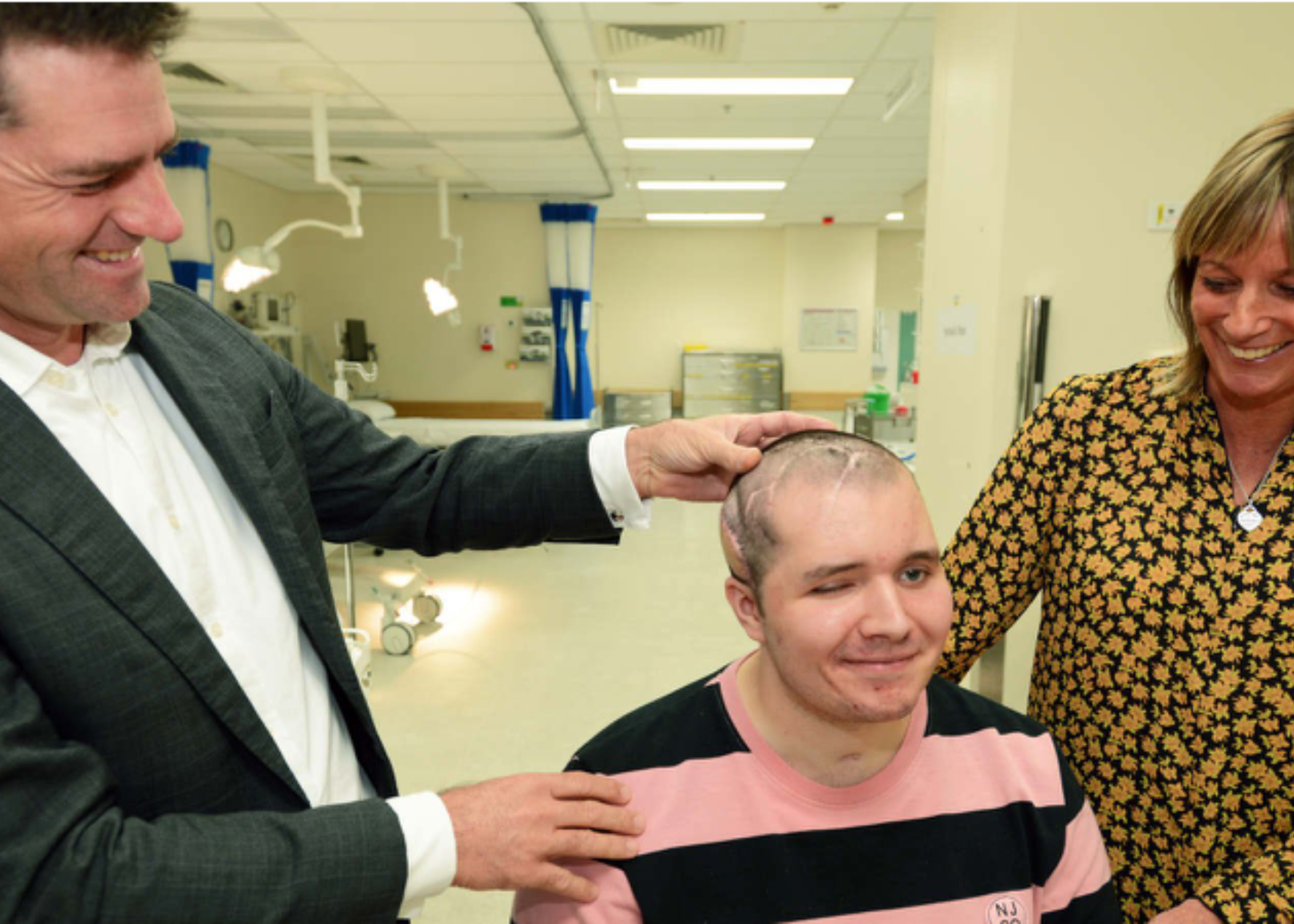

Brody Ellis survived a severe motorcycle accident in Vietnam and lost part of his skull. Today, his own bone is growing back, supported by a 3D-printed implant used in this way for the skull for the first time in the world.
Based on reporting by ABC News Australia, written by Stuart Layt and published on June 2, 2020.
The accident that changed everything
In 2018, Brody Ellis was involved in a severe motorcycle accident in Vietnam. He sustained serious head injuries as well as extensive trauma to his left leg, which later had to be amputated.
Because of the damage to his skull, surgeons had to remove sections of bone from both sides of his head. Later that year, Brody received plastic 3D-printed implants to close the resulting defects. However, one of the implants subsequently became infected.
When a conventional implant is not enough
Dr. Michael Wagels, Deputy Director of Plastic and Reconstructive Surgery at Princess Alexandra Hospital, explained that the staphylococcal infection posed a serious risk. Because the plastic implant had no blood supply of its own, the body was unable to effectively fight the infection around it.
The implant had to be removed.
Rather than replacing it with another conventional plastic implant, the surgeon proposed a different approach: using a newer type of implant designed to support the regeneration of Brody’s own bone across the damaged area.
A scaffold that disappears as bone grows
According to Dr. Wagels, he and his colleagues had already been experimenting with 3D-printed implants that act as temporary scaffolds. They provide a structure for bone growth and then gradually dissolve as newly formed bone tissue occupies the space.
The team had previously used a similar technology to reconstruct bone in a patient’s leg, but this was the first time in the world that the approach had been used for the skull.
The operation lasted 11 hours.
First results after just six weeks
Follow-up CT scans showed that new bone tissue had begun forming along both the outer and inner surfaces of the implant just six weeks after surgery. No complications were reported at that stage.
People with substantial skull defects may need to wear protective helmets in public and can experience severe headaches associated with pressure changes affecting the brain. With the new implant in place, Brody was able to avoid this problem and focus on his rehabilitation.
Brody himself admitted that the idea of “growing bone back in his head” initially sounded almost unbelievable, but the result exceeded his expectations.
His surgeon, meanwhile, emphasized that much of the progress was also due to Brody’s own determination and persistence throughout his recovery.